2010年10月8日星期五
Public Art and the Culture of a City
Public Art, especially in the form of architecture or sculpture, is the best reflection of the culture of a city. They can make a direct impression on the tourists what the city is like, what residence in the area likes to do or what the city is famous for.
The city where I come from, Dalian (in the northeast of China), for example, is famous for its soccer team. We were once the national champion for 10 consecutive years! And the team of Dalian can easily out-perform our National Team. Therefore, our city decided to build a giant football in downtown area as tall as 100-feet! There's another big football in the CBD around Central Plaza. It is transparent and can emit different colors of light at night.
These two giant footballs are the symbol of Dalian, as a city of soccer sport. They are now the most frequently visited place in our city today.
2010年10月3日星期日
Micro-photography: Not only a change of way of seeing (3)
Let's take a look at the big-guns we are using in Micro-photography: microscopes.
This is an optic microscope, the most commonly-used observing tool in Biology. It is not a high-techie tech that emerged in recent years. Its history traces back to more than 300 years ago, when Robert Hooke, an English scientist built the first optic microscope from the inspiration of Galileo's telescopes. Yes, it does works similarly with refracting telescopes: they all use a set of convex lenses to magnify the objects. But microscopes deal with very small objects at a very close distance, while telescopes are used to watch distant stars and galaxies. Though the theory is very simple-even a high school student today knows how it works-it is not so easy to make one. As the power increases, the lens needs to be polished very precisely, and the composition of glass used for making lenses becomes very important because even a tiniest bit of impurity would disable the microscope from working. Therefore, only a few manufacturers in the world can build high-power optic microscopes, with up to 2500x magnification power.
Though the magnification power is enough to observe most of the microscopic cells and crystals, optic microscopes are rarely used in micro-photography because they work poorly with cameras. Cameras also use sets of lenses to form images, so optical distortions may occur if these lenses are combined with the lenses in the microscopes. There are, in fact, some microscopes that work in coordinate with cameras, but they are hard to build, even more complicated than the other type of microscope I'm introducing next, the Electron Microscope.
The invention of electron microscopes is definitely one of the biggest victory of Quantum Physics (another one is CD-Player). In wave-particle dualism theory, any substance in the world have both characters of wave and particle. But we never consider ourselves a bunch of waves because our wavelength is too small to measure, only sub-atomic particles travelling at high speeds can express an observable dualism, one example is electron.
But why electron instead of light? This is because the wavelength of visible light is 390-780 nm. Higher magnification power means shorter focus length. As the power goes to beyond 1600x, the focus length is so close to the wavelength of visible light that the light no longer focus in the manner it has to be. Thus, we can barely get a clear image when the power is too high. One solution is using UV rays, and this can extend the ability of optic microscopes to 2500x. But still, 2500x is not enough to let us see viruses or molecules.
Therefore, we use electrons, which has a wavelength of only 0.1 nm. Though electrons don't focus when going through a lens, they can focus in magnetic fields. Now imagine a combination of an electron accelerator and a magnetic lens-how similar it is to an optic microscope! It is true that electron microscopes work just in the same way of an optic one. The only difference is the "light" we are using, namely high speed electrons and visible light.
Electron microscopes work in coordinate with electron sensors, so when electrons hit the sensor, a dot will appear on the screen. Thus we can directly have an image without observing it with our own eyes (caution: human cannot detect electron rays, but they are harmful to eyes). What's more, by adjusting the speed of electron and the intensity of magnetic field, we can get any magnification power we want. In comparison, optic microscopes can only provide a certain sets of power and the photographer may be caught in the dilemma of having either too big or too small pictures.
All these advantages make electron microscopes the favorite of many micro-photographers. Over 90% of the micro-photos are taken by electron microscopes.
Compared to this gigantic monster, however, even electron microscopes are but an entertainmant-level equipment. This is the STM (scanning tunnel microscopes), the most delicate machine on the planet-it requires even higher precision than building a spaceship. It is the only thing that can bring us to atomic level-namely less than 0.1nm. Their working principle is very complicated so I'm not going to introduce it here. The only thing you need to know is: it has a magnification power of over a million times!
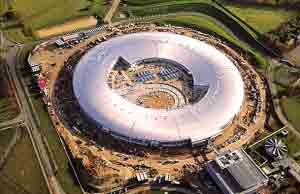
The picture above shows only the smallest STM, take a look at this guy! It is the biggest microscope ever built, finished in 2007 in Oxford University, UK. Its size is equivalent to 5 soccer fields, or 150 meters in diameter. It can produce the highest light intensity in the whole universe: 1 million times brighter than all the light source ever detected in the universe! What a monster!
2010年9月26日星期日
The multi-dimension world (2)
It's time to do some maths! But don't be afraid, this has nothing to do with Taylor's Theorem or Integration. It's all about imagination.
Suppose you are a "2-D Human", that means, you have only length and height, but no width (a good news for ones who want to keep fit lol), you happened to have an opportunity to take a trip to the 3-D world. How would you explain that fantastic world to your poor fellows who have never been there?
Parallel projection may be a good solution. As we all know, the projection of a sphere on the 2-D plane is a circle. Therefore, if you live in 2-D world, you can say "a circle is the projection of a 3-D object, sphere. *
But parallel projection does not always work. What would the projection of a cube like? You may say it's a square. Well, it is in most cases. But what about if you turn it over a bit and take one of its vertices as the top instead of a whole surface? The projection would be a hexagon (try it by folding a paper cube by yourself). Thus, we need another method to describe a polyhedron in 2-D plane. And the Ancient Greek geometrist Hipparchus gave us the answer, stereographic projection.
You will know how it works in the video shown below. Here's a brief summary in order that you won't get lost. Sphere is a very interesting 3-D object: it is 2-dimensional as it has only one surface, but occupies 3-D space, and thus we call the sphere in 3-D space a "2-D Sphere" (a similar object is the Mobius Band that we are very familiar with). By expanding the polyhedron to a sphere, the points on the surfaces of the polyhedron now lie on the same surface instead of different surfaces. Therefore, stereographic projection works in any circumstances because it can describe the relationship of any two points on the polyhedron.
*some important instructions: It is worth noting that even if you, as the lucky "2-D man", know what the projection is like, you will never form a explicit impression of what a sphere is exactly like because your brain is "2-D"(without the ability to construct 3-D feelings). This is a trap many people got stuck into when learning N-D geometry. The correct method to learn abstract geometry is not figuring out what they look like in N-D space, but what they look like in 3-D space(or 2-D space in the "2-D man"'s perspective).
Micro-photography: Not only a change of way of seeing (2)
Take a look at this picture:
Looks like a pelican soaring up from the water, doesn't it? The wings, the body, the neck and the long beak are clearly recognizable. Well, you will not be blamed if what you guess is a light-year away from the true answer because even professionals can't tell.
The true object depicted in this image is the iris, ciliary body and lens of a canine (dog) eye. It is magnified 7.7X under an electron microscope. Who can ever think of a dog's eye when he/she is shown a picture like this?
This is the fascination of micro-photography. It totally challenges our conventional thinkings. As the saying goes "seeing is believing", for a long period of time, we limit our mind to what we can see, but not things we can't see. When micro-photography is introduced, seeing is no longer believing because it is impossible for our bare eye to figure out what it a microscopic object is really like. Therefore, micro-photos can significantly improve our imagination, just like an abstract painting does.
Another important role, and the most essential function of micro-photography, is to unveil the nature's mystery. What makes human-being different from other creatures on the plant is that we are not limited by the organic body mother nature has given us. Though we cannot see into microscopic levels, by using high multiplication microscopes, the things nature hides from our eyes can also be revealed. The meter-level world in which we are living extend to nano scale. It has not only scientific research values, but also great influence in promoting science to ordinary people.
Compared to formulas and equations, pictures are more appealing to the public without sufficient science education. Micro-photos tend to be eye-catching due to their unique patterns, complicated structures and diversified coloration. This makes science studying microscopic world easier to accept to the public.
OK, now it's time for some guesses!
The true object depicted in this image is the iris, ciliary body and lens of a canine (dog) eye. It is magnified 7.7X under an electron microscope. Who can ever think of a dog's eye when he/she is shown a picture like this?
This is the fascination of micro-photography. It totally challenges our conventional thinkings. As the saying goes "seeing is believing", for a long period of time, we limit our mind to what we can see, but not things we can't see. When micro-photography is introduced, seeing is no longer believing because it is impossible for our bare eye to figure out what it a microscopic object is really like. Therefore, micro-photos can significantly improve our imagination, just like an abstract painting does.
Another important role, and the most essential function of micro-photography, is to unveil the nature's mystery. What makes human-being different from other creatures on the plant is that we are not limited by the organic body mother nature has given us. Though we cannot see into microscopic levels, by using high multiplication microscopes, the things nature hides from our eyes can also be revealed. The meter-level world in which we are living extend to nano scale. It has not only scientific research values, but also great influence in promoting science to ordinary people.
Compared to formulas and equations, pictures are more appealing to the public without sufficient science education. Micro-photos tend to be eye-catching due to their unique patterns, complicated structures and diversified coloration. This makes science studying microscopic world easier to accept to the public.
OK, now it's time for some guesses!
2010年9月12日星期日
Overwhelmed by the assignments and exams? Look at the beautiful side of maths! (1)
Maths is, in the view of many fellows here in Georgia Tech, as one of the most dreadful and annoying courses. I can't agree more with that! The maths assignments are really hard to solve, lots of equations need to be memorized and lots of nerve-killing provings are exhausting the last bit of our brain capacity! But don't feel desperate about maths; it is, infact, the most beautiful field of science.
Geometry is not just about triangles and circles, it is very extensive when you look beyond 2-dimensional space. In this series of posts, I would like to introduce you to the multi-dimensional world, in which you will see incredible geometric variations, the delicate microscopic structure of a mandelbrot set and intersecting Mobius Rings that construct multi-dimensional objects.
After watching these videos, there are several possibilities. One is that you will become a fanatic of mathematics because you are so stroken by the incredible images. Or, you will end up "dead"(lol) thinking "why is it like this?", "how do mathematicians figure out what things should be like in a dimension that even themselves cannot see?" I would recommend that do not ask why, because you don't need to know why! Just enjoy the beauty of geometry!
The video is with chinese subtitle because in China I attended a subtitle group, which translates English learning materials so that our firends can also understand them.
Episode 1 (The video quality is very poor because this is my first time uploading a video on YouTube, I'm working on it to get an HD video format)
http://www.youtube.com/watch?v=Xif0DYi6bM4
Geometry is not just about triangles and circles, it is very extensive when you look beyond 2-dimensional space. In this series of posts, I would like to introduce you to the multi-dimensional world, in which you will see incredible geometric variations, the delicate microscopic structure of a mandelbrot set and intersecting Mobius Rings that construct multi-dimensional objects.
After watching these videos, there are several possibilities. One is that you will become a fanatic of mathematics because you are so stroken by the incredible images. Or, you will end up "dead"(lol) thinking "why is it like this?", "how do mathematicians figure out what things should be like in a dimension that even themselves cannot see?" I would recommend that do not ask why, because you don't need to know why! Just enjoy the beauty of geometry!
The video is with chinese subtitle because in China I attended a subtitle group, which translates English learning materials so that our firends can also understand them.
Episode 1 (The video quality is very poor because this is my first time uploading a video on YouTube, I'm working on it to get an HD video format)
http://www.youtube.com/watch?v=Xif0DYi6bM4
Micro-photography: Not only a change of way of seeing (1)
I am quite confused that those artists and scholars on art with conventional thinking are so opposed to modern photographic technique. They limit themselves to the ordinary photography, which they think contain less "connotation" and "authority" than a painting or sculpture. In their points of view, photography is a part of fast-food culture; people get information so directly that they no longer look deeply into the inner quintessense of the image. In a word, photography changes the way of seeing, making it a lot easier but in the price of fewer connotative elements.
It is, partly true, but they are so shortsighted that they neglected the technological development in photography. These advancements in science and technology created a new type of art: microscopic images.
Before electron microscopes were invented, it is impossible for human being to see anything on molecular level. Optic microscopes are strong enough, still what they can present is only a 2-dimensional colorless flat image. What's more, they work poorly in cooperation with cameras because the combination of the lens in the microscope and that in a camera may result in serious optic distortion.
In the 1950s, however, electron microscopes expanded our sights 100 times further, enabling scientists to have a look of the world of molecules and cells. Soon they found out that the images they were looking at are so astonishing and delicate. For the first time, we know that the hypnotizing chemical signs written on the whiteboard or lethal bacterium can be so beautiful when we have a real look at them. Those powerful instruments created not only a new form of art, but also a brand-new world we've nevered imagined.
After that, techniques for micro-photography developed quickly. STM(Scanning Tunnel Microscope), an enhanced version of electron microsope extended our sight to subatomic level. Advancement in coloration and computer graphics endow the image with color and a stereoscopic impression.
This semester I would like post a series of micro-images from Nikon Small World, the world's most authoratative microphotography forum sponsored by the world's leading optic instrument manufacturer Nikon. In the first post of this series, I would like to attach one of the eye-catching images and guess what it is!
It is, partly true, but they are so shortsighted that they neglected the technological development in photography. These advancements in science and technology created a new type of art: microscopic images.
Before electron microscopes were invented, it is impossible for human being to see anything on molecular level. Optic microscopes are strong enough, still what they can present is only a 2-dimensional colorless flat image. What's more, they work poorly in cooperation with cameras because the combination of the lens in the microscope and that in a camera may result in serious optic distortion.
In the 1950s, however, electron microscopes expanded our sights 100 times further, enabling scientists to have a look of the world of molecules and cells. Soon they found out that the images they were looking at are so astonishing and delicate. For the first time, we know that the hypnotizing chemical signs written on the whiteboard or lethal bacterium can be so beautiful when we have a real look at them. Those powerful instruments created not only a new form of art, but also a brand-new world we've nevered imagined.
After that, techniques for micro-photography developed quickly. STM(Scanning Tunnel Microscope), an enhanced version of electron microsope extended our sight to subatomic level. Advancement in coloration and computer graphics endow the image with color and a stereoscopic impression.
This semester I would like post a series of micro-images from Nikon Small World, the world's most authoratative microphotography forum sponsored by the world's leading optic instrument manufacturer Nikon. In the first post of this series, I would like to attach one of the eye-catching images and guess what it is!
订阅:
博文 (Atom)